
Saudi Arabia relies more heavily on migrant labour than any other large country.

An aggressive Pyongyang is likely to force Seoul and Tokyo to build nuclear deterrents and thus thwart Beijing's ambitions.

The two countries also decided to expand trade and commercial ties holding that there are opportunities to exploit untapped economic potential in the two countries.

One thing Beijing must understand is that India is not obsessed with being a threat to China but only wants a rightful place for itself in the world, says Sanjeev Nayyar.

'While economic ties are making incremental progress, it is in the security and strategic domains that the India-Japan synergy is more compelling,' says Dr Rajaram Panda.

December 3, 2021 marks 50 years since the beginning of the 1971 War which ended in a decisive military victory for India and the liberation of Bangladesh. Most analysts of the 1971 War agree that the IV Corps dash across the mighty Meghna river led by the brilliant General Sagat Singh was the turning point in the war, recalls military historian Colonel Anil A Athale (retd).

'But India, increasingly, is not that far behind, which is a story I never expected to tell.'

It was clear in Brunei at the 8th East Asia Summit that China doesn't want the South China Sea issue to even dominate the discussion, reports Sheela Bhatt, who is part of the prime minister's media contingent to the summit

China is pulling out all the stops to give a 'state visit-plus' reception to Trump on his maiden visit.

New Delhi remains a priggish suitor to Washington's overtures, but it has begun appreciating potential tech benefits to ties with the US.

'In India foreign policy is generally handled by the prime minister.' 'One can clearly see the Vajpayee stamp on all this.' 'Only a person with poetic imagination can weave such a complex web,' says Colonel Anil A Athale (retd).

'Pakistan persists in the belief that such attacks will enable it to obtain the territory it covets. Their plans will not succeed.'
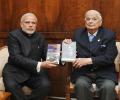
Tarun Vijay, MP, salutes the General whom he adored as a great friend.

'Trump's stated strong stance against Islamist extremism and terrorism could play into the Indo-US relationship.' 'It could mould US attitude and exert pressure on Pakistan.' 'In the event of US military presence in Afghanistan increasing, however, Pakistan could gain an opportunity to again emphasise its importance.'

Both the separatists in the Valley and the Indian establishment have failed to fathom that the world's alignments have changed, writes Col Dr Anil Athale (retired).

'Whether it's investments in Kashmir, building naval facilities, or selling top-of-the-range military equipment, Pakistan could well benefit more under Xi's watch.' 'Do Chinese concerns about the 'Islamisation' of Pakistan give it pause about how quickly to move forward with security and economic projects? At the moment the indication is quite the opposite: China is doubling down on its support to Pakistan, partly because of its fears about where the country is headed.'
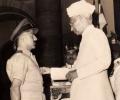
Claude Arpi reveals how Wing Commander Jag Mohan Nath won a second Maha Vir Chakra in the 1965 War.

It's been 100 years since Lenin and the Bolsheviks overthrew the government, and its legacy remains visible even today in the buildings and monuments scattered throughout St Petersburg.
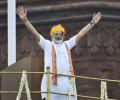
Following is the full text of Prime Minister Narendra Modi's address from the ramparts of the Red Fort on the 73rd Independence Day.

Both India and South Korea will use President Park Geun-hye's visit to unveil a comprehensive programme for mutual benefit and impacting on regional security environment, says Srikanth Kondapalli.
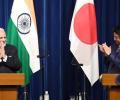
'Relations between India and Japan are robust and devoid of either shadow of history or any irritant.' 'In fact, there is plenty of warmth and goodwill earned over history. There are no negatives but only opportunities,' notes Dr Rajaram Panda.

'What we are today witnessing is the final act of the Pakistani army trying to retain its turf,' argues Colonel Anil A Athale (retd).
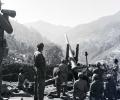
Fifty years ago, India and Pakistan fought a short but bloody war. The author finds out how Sainik Samachar, the defence ministry's journal, reported it.

'India is no longer the India of the '70s and the '80s.' 'It's a large country with the fastest growing economy.' 'In working with India, you just can't go and humiliate the nation publicly.' USIBC President Mukesh Aghi tells Aziz Haniffa/Rediff.com about how he advises American companies to do business with India, what he thinks of Modi's government and the way forward for the India-US relationship.

With Beijing having had a profound rethink on India's admission as a full member of the Shanghai Cooperation Organisation, the tectonic plates of the geopolitics of a massive swathe of the planet stretching from the Asia-Pacific to West Asia are dramatically shifting. That grating noise in the Central Asian steppes will be heard far and wide -- as far as North America, says Ambassador M K Bhadrakumar.
 © 2026 Rediff.com - Advertise with us - Disclaimer - Privacy Policy - Sitemap - Feedback - About us - Terms of use - Grievances